May 29, 2021

THE SQUIRREL BY MILDRED BOWERS ARMSTRONG

THE SQUIRREL 
MILDRED BOWERS ARMSTRONG


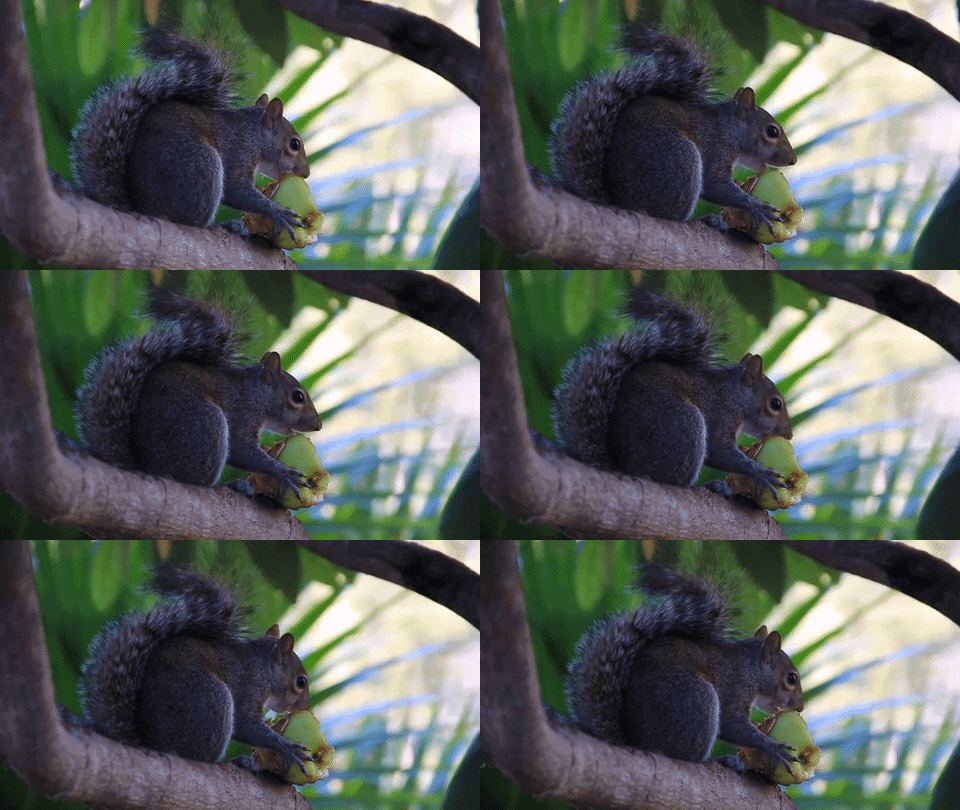
You may have seen a squirrel sitting on the ground eating a nut. What did it look like? Here is a poet’s description of just such a squirrel.


He wore a question mark for tail,

An overcoat of gray,

He sat up straight to eat a nut.

He liked to tease and play,

And if we ran around his tree,

He went the other way.

May 25, 2021

AJAMIL AND THE TIGERS BY ARUN KOLATKAR

AJAMIL AND THE TIGERS 
ARUN KOLATKAR


Arun Kolatkar (1932–2004) is a contemporary Indian poet. He was educated in Pune and earned a diploma in painting from the J.J. School of arts, Mumbai. He writes both in English and Marathi and has authored two books. The present poem is an excerpt from Jejuri— a long poem in thirty-one sections. A German translation of Jejuri by Gievanen Bandin was published in 1984.


The tiger people went to their king

and said, ‘We’re starving.

We’ve had nothing to eat,

not a bite,

for 15 days and 16 nights.

Ajamil has got

a new sheep dog.

He cramps our style

and won’t let us get within a mile

of meat.’

‘That’s shocking,’

said the tiger king.

‘Why didn’t you come to see me before?

Make preparations for a banquet.

I’m gonna teach that sheep dog a lesson he’ll never

forget.’

‘Hear hear,’ said the tigers.

‘Careful,’ said the queen.

But he was already gone.

Alone

into the darkness before the dawn.

In an hour he was back,

the good king.

A black patch on his eye.

His tail in a sling.

And said, ‘I’ve got it all planned

now that I know the lie of the land.

All of us will have to try.

We’ll outnumber the son of a bitch.

And this time there will be no hitch.

Because this time I shall be leading the attack.’

Quick as lightning

the sheep dog was.

He took them all in as prisoners of war,

the 50 tigers and the tiger king,

before they could get their paws

on a single sheep.

They never had a chance.

The dog was in 51 places all at once.

He strung them all out in a daisy chain

and flung them in front of his boss in one big heap.

‘Nice dog you got there, Ajamil,’

said the tiger king.

Looking a little ill

and spiting out a tooth.

‘But there’s been a bit of a misunderstanding.

We could’ve wiped out your herd in one clean sweep.

But we were not trying to creep up on your sheep.

We feel that means are more important than ends.

We were coming to see you as friends.

And that’s the truth.’

The sheep dog was the type

who had never told a lie in his life

He was built along simpler lines

and he was simply disgusted.

He kept on making frantic signs.

But Ajamil, the good shepherd

refused to meet his eyes

and pretended to believe every single word

of what the tiger king said.

And seemed to be taken in by all the lies.

Ajamil cut them loose

and asked them all to stay for dinner.

It was an offer the tigers couldn’t refuse.

And after the lamb chops and the roast,

when Ajamil proposed

they sign a long term friendship treaty,

all the tigers roared.

‘We couldn’t agree with you more.’

And swore they would be good friends all their lives

as they put down the forks and the knives.

Ajamil signed a pact

with the tiger people and sent them back.

Laden with gifts of sheep, leather jackets and balls of

wool.

Ajamil wasn’t a fool.

Like all good shepherds he knew

that even tigers have got to eat some time.

A good shepherd sees to it they do.

He is free to play a flute all day

as well fed tigers and fat sheep drink from the same

pond

with a full stomach for a common bond.

ODE TO A NIGHTINGALE BY JOHN KEATS

ODE TO A NIGHTINGALE 

JOHN KEATS


John Keats (1795–1821) was one of the greatest of the younger generation of ‘English Romantic’ poets. He started his career as an apprentice to a surgeon but soon gave it up for poetry. His poetic career lasted for only four years but, during this short span, he evolved from an ordinary poet to an exceptionally mature poetic force. His poetry celebrates beauty, which he considered the ultimate truth. It is portrayed in extremely sensuous images that have been created through beautiful verbal pictures. The image of the nightingale’s bower in the poem is an apt illustration of the poet’s craft in this respect.

ODE TO A NIGHTINGALE BY JOHN KEATS


My heart aches, and a drowsy numbness

pains

My sense, as though of hemlock I had

drunk,

Or emptied some dull opiate to the drains

One minute past, and Lethe-wards had

sunk:

’Tis not through envy of thy happy lot,

But being too happy in thine happiness,

That thou, light-winged Dryad of the trees,

In some melodious plot

Of beechen green, and shadows

numberless,

Singest of summer in full-throated ease.

O, for a draught of vintage! that hath been

Cool’d a long age in the deep-delved earth,

Tasting of Flora and the country green,

Dance, and Provencal song, and sunburnt

mirth!

O, for a beaker full of the warm South,

Full of the true, the blushful Hippocrene,

With beaded bubbles winking at the brim,

And purple-stained mouth;

That I might drink, and leave the world

unseen,

And with thee fade away into the forest

dim.

***

Fade far away, dissolve, and quite forget

What thou among the leaves hast never

known

The weariness, the fever, and the fret

Here, where men sit and hear each other

groan;

Where palsy shakes a few, sad, last gray

hairs,

Where youth grows pale, and spectre-thin,

and dies;

Where but to think is to be full of sorrow

And leaden-eyed despairs,

Where Beauty cannot keep her lustrous

eyes,

Or new Love pine at them beyond tomorrow.

Thou wast not born for death, immortal

Bird!

No hungry generations tread thee down;

The voice I hear this passing night was

heard

In ancient days by emperor and clown:

Perhaps the self-same song that found a

path

Through the sad heart of Ruth, when, sick

for home,

She stood in tears amid the alien corn;

The same that oft-times hath

Charm’d magic casements, opening on the

foam

Of perilous seas, in faery lands forlorn.

***

Forlorn! the very word is like a bell

To toll me back from thee to my sole self!

Adieu! the fancy cannot cheat so well

As she is fam’d to do, deceiving elf.

Adieu! adieu! thy plaintive anthem fades

Past the near meadows, over the still

stream,

Up the hill-side; and now ’tis buried deep

In the next valley-glades:

Was it a vision, or a waking dream?

Fled is that music:—Do I wake or sleep?

FELLING OF THE BANYAN TREE BY DILIP CHITRE

FELLING OF THE BANYAN TREE 
DILIP CHITRE


Dilip Chitre (1938–2009) was born in Baroda. He writes poetry both in Marathi and English. Travelling in a Cage, from which the poem selected here has been taken, was published in 1980. Apart from poetry, Chitre has also written short stories and critical essays. An Anthology of Marathi Poetry 1945–1965 is one of his most important works of translation. He sees poetry as an expression of the spirit. He lives and works in Mumbai.


My father told the tenants to leave

Who lived on the houses surrounding our house on the hill

One by one the structures were demolished

Only our own house remained and the trees

Trees are sacred my grandmother used to say

Felling them is a crime but he massacred them all

The sheoga, the oudumber, the neem were all cut down

But the huge banyan tree stood like a problem

Whose roots lay deeper than all our lives

My father ordered it to be removed

The banyan tree was three times as tall as our house

Its trunk had a circumference of fifty feet

Its scraggy aerial roots fell to the ground

From thirty feet or more so first they cut the branches

Sawing them off for seven days and the heap was huge

Insects and birds began to leave the tree

And then they came to its massive trunk

Fifty men with axes chopped and chopped

The great tree revealed its rings of two hundred years

We watched in terror and fascination this slaughter

As a raw mythology revealed to us its age

Soon afterwards we left Baroda for Bombay

Where there are no trees except the one

Which grows and seethes in one’s dreams, its aerial roots

 Looking for the ground to strike.

REFUGEE BLUES BY WYSTAN HUGH AUDEN

REFUGEE BLUES 
WYSTAN HUGH AUDEN


Wystan Hugh Auden (1907–1973) was a student and later a Professor of Poetry at Oxford University. One of the most important poets of the century, he has published several collections of poems noted for their irony, compassion and wit. Although a modern poem, ‘Refugee Blues’ uses the ballad form of narration.


Say this city has ten million souls,

Some are living in mansions, some are living in holes:

Yet there’s no place for us, my dear, yet there’s no

place for us.

Once we had a country and we thought it fair,

Look in the atlas and you’ll find it there:

We cannot go there now, my dear, we cannot go there

now.

In the village churchyard there grows an old yew,

Every spring it blossoms anew:

Old passports can’t do that, my dear, old passports

can’t do that.

The consul banged the table and said:

‘If you’ve got no passport you’re officially dead’;

But we are still alive, my dear, but we are still alive.

Went to a committee; they offered me a chair;

Asked me politely to return next year;

But where shall we go today, my dear, but where shall

we go today?

Came to a public meeting; the speaker got up and said:

‘If we let them in, they will steal our daily bread’;

He was talking of you and me, my dear, he was talking

of you and me.

Thought I heard the thunder rumbling in the sky;

It was Hitler over Europe, saying: ‘they must die’;

We were in his mind, my dear, we were in his mind.

Saw a poodle in a jacket fastened with a pin;

Saw a door opened and a cat let in:

But they weren’t German Jews, my dear, but they

weren’t German Jews.

Went down the harbour and stood upon the quay,

Saw the fish swimming as if they were free:

Only ten feet away, my dear, only ten feet away.

Walked through a wood, saw the birds in the trees;

They had no politicians and sang at their ease:

They weren’t the human race, my dear, they weren’t

the human race.

Dreamed I saw a building with a thousand floors,

A thousand windows and a thousand doors;

Not one of them was ours, my dear, not one of them

was ours.

Went down to the station to catch the express,

Asked for two tickets to Happiness;

But every coach was full, my dear, every coach was

full.

Stood on a great plain in the falling snow;

Ten thousand soldiers marched to and fro:

Looking for you and me, my dear, looking for you and me.

FOR ELKANA BY NISSIM EZEKIEL

FOR ELKANA 
NISSIM EZEKIEL


Nissim Ezekiel (1924–2004) was born in Mumbai. He is today perhaps the best known Indian poet to have written in English. He had his education at Wilson College, Bombay and later at Birbeck College, London. A professor of American Literature at Bombay University, Ezekiel has written several poems and some plays. A proficient critic, Ezekiel lectured at a number of universities in the U.S.A. and the U.K.


The warm April evening

tempts us to the breezes

sauntering across the lawn.

We drag our chairs down

the stone steps and plant them there.

Unevenly, to sit or rather sprawl

in silence till the words begin to come.

My wife, as is her way,

surveys the scene, comments

on a broken window-pane.

Suggests a thing or two

that every husband in the neighbourhood

knows exactly how to do

except of course the man she loves

who happened to be me.

Unwilling to dispute

the obvious fact.

that she is always right,

I turn towards the more

attractive view that opens up

behind my eyes and shuts her out.

Her voice crawls up and down the lawn,

our son, who is seven,

hears it—and it reminds him of something.

He stands before us,

his small legs well apart,

crescent-moon-like chin uplifted

eyes hard and cold

to speak his truth

in masterly determination:

Mummy, I want my dinner, now.

Wife and husband in unusual rapport

state one unspoken thought:

Children Must be Disciplined.

She looks at me. I look away.

The son is waiting. In another second

he will repeat himself.

Wife wags a finger.

Firmly delivers verdict: Wait.

In five minutes I’ll serve you dinner.

No, says the little one,

not in five minutes, now.

I am hungry.

It occurs to me the boy is like his father.

I love him as I love myself.

Wait, darling, wait,

Mummy says, wait for five minutes

But, I am hungry now,

declaims the little bastard, in five minutes

I won’t be hungry any more.

This argument appeals to me.

Such a logician deserves his dinner straightaway.

My wife’s delightful laughter

holds the three of us together.

We rise and go into the house.

HAWK ROOSTING BY TED HUGHES

HAWK ROOSTING 

TED HUGHES


Ted Hughes (1930–1998) completed his education at Pembroke College, Cambridge. In 1956, he married the poet Sylvia Plath. He tried to make a living in America by teaching and writing. Finally, he returned to England. The most remarkable quality of Hughes’ poems is an intense and obsessive fascination with the world of birds and animals; and though essentially about birds, animals and fishes, his poems shock us with unusual phrases and violent images. The above poem is in the form of a monologue.

HAWK ROOSTING BY TED HUGHES


I sit in the top of the wood, my eyes

closed.

Inaction, no falsifying dream

Between my hooked head and hooked

feet:

Or in sleep rehearse perfect kills and eat.

The convenience of the high trees!

The air’s buoyancy and the sub’s ray

Are of advantage to me;

And the earth’s face upward for my inspection.

My feet are locked upon the rough bark.

It took the whole of Creation

To produce my foot, my each feather:

Now I hold Creation in my foot.

Or fly up, and revolve it all slowly-

I kill where I please because it is all mine.

There is no sophistry in my body:

My manners are tearing off heads.

The allotment of death.

For the one path of my flight is direct

Through the bones of the living.

No arguments assert my right.

The sun is behind me.

Nothing has changed since I began,

My eye has permitted no change.

I am going to keep things like this.